Golf Course Type Finder
Find Your Perfect Golf Course Type
Discover which golf course type matches your preferences and playing style. Based on the article content, different courses offer unique challenges and experiences.
Ever walked onto a golf course and wondered why it’s called that? Or maybe you’ve heard terms like ‘links’, ‘parkland’, or ‘desert course’ and weren’t sure what they actually mean. The truth is, not all golf courses are the same-and they don’t all just get called ‘golf courses’. The name tells you a lot about how it was built, where it is, and even how it plays.
It’s Not Just a ‘Golf Course’
Calling every piece of land with holes and grass a ‘golf course’ is like calling every building a ‘house’. Sure, they all serve the same basic purpose, but the details change everything. Golf courses come in distinct types, each shaped by geography, history, and design philosophy. These types have real names-and knowing them helps you understand the game better.
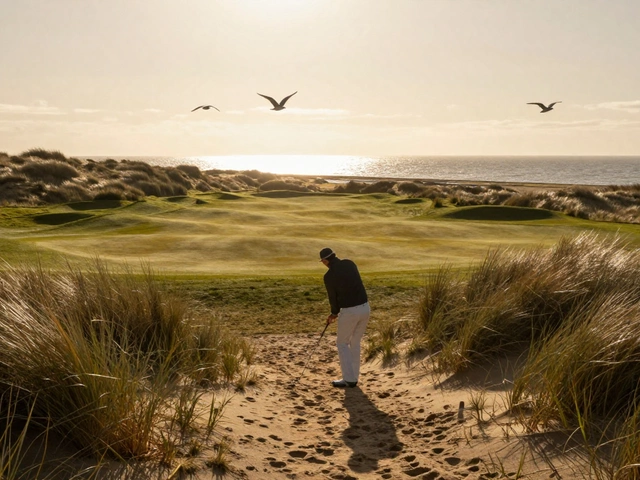
The most common term you’ll hear is ‘links course’. It’s not just a fancy word. It refers to the original golf courses, built along the coastlines of Scotland and Ireland. These courses sit on sandy, treeless land near the sea, with natural dunes, tall grasses, and unpredictable wind. The word ‘links’ comes from the Old English ‘hlinc’, meaning rising ground or ridge. There are no manicured trees here-just rough, wind-swept terrain that challenges your ball flight and shot shaping. St Andrews Links in Scotland? That’s the birthplace of golf, and it’s still a true links course today.
Parkland Courses: The Greenest of the Green
If you’ve ever played a course surrounded by tall trees, lined with flower beds, and dotted with ponds, you’re on a parkland course. These are the most common type in the U.S., Canada, and parts of Europe. They’re designed to look like elegant parks-lush, orderly, and carefully maintained. Unlike links courses, parkland courses rely on irrigation, planted trees, and controlled grass types like bentgrass or poa annua. The challenge here isn’t wind-it’s precision. Narrow fairways, water hazards, and thick rough demand accurate iron play. Think of Augusta National, home of the Masters. It’s a parkland course through and through.
Desert Courses: Sand, Rock, and Dry Heat
In Arizona, Nevada, and parts of California, you’ll find desert courses. These are built in arid regions where natural vegetation is sparse. Instead of grassy roughs, you’ve got cacti, sagebrush, and rocky outcrops. Water is scarce, so these courses use drought-resistant grasses like Bermuda or zoysia. The sand traps here aren’t just hazards-they’re part of the natural landscape. The key to playing these courses? Don’t panic when your ball lands in the desert. Many times, it’s just part of the view. Troon North in Scottsdale is a classic example. It doesn’t look like a traditional golf course-it looks like the American Southwest.
Mountain Courses: High Altitude, Thin Air
Play a course in Colorado, the Swiss Alps, or the mountains near Adelaide’s Barossa Valley, and you’ll notice something different: the ball flies farther. That’s because at higher elevations, the air is thinner. Less air resistance means your drives carry 10-15% farther than at sea level. Mountain courses often have steep elevation changes, narrow fairways carved into hillsides, and dramatic drop-offs. The challenge isn’t just the terrain-it’s adjusting your club selection. You might hit a 7-iron on the flat and need a 9-iron on the mountain. Courses like The International in Colorado Springs or the Royal Melbourne West Course (with its elevated tees) are built to take advantage of-and fight against-altitude.

Coastal and Island Courses: Wind, Salt, and Views
These aren’t just links courses with a nice ocean view. Coastal and island courses are built on peninsulas, barrier islands, or seaside cliffs. They often combine elements of links and parkland-think sandy waste areas, salt-tolerant grasses, and ocean breezes that shift direction every few holes. The wind here isn’t just a nuisance-it’s a strategic factor. You might need to hit a fade into the wind on one hole, then a draw with the wind on the next. Pebble Beach in California is the most famous example. It’s not just a course-it’s a postcard with hazards.
Executive and Short Courses: Less Than 18 Holes
Not every course is built for 18 holes of full-power drives. Executive courses, also called short courses or par-3 courses, are designed for quicker rounds. These typically have 9-12 holes, all under 200 yards. They’re great for beginners, families, or anyone short on time. Some even have mini-golf-style holes with obstacles. They’re not ‘easier’ just because they’re shorter-they test your short game, putting, and course management in ways full-size courses don’t. You’ll find these tucked into suburban areas, near shopping centers, or even inside resorts. They’re the gateway for new players and the warm-up for pros.
Private vs. Public vs. Resort Courses
Beyond the terrain, courses are also categorized by who can play them. Private courses require membership-think country clubs with strict dress codes and waiting lists. Public courses are open to anyone who pays a fee. Resort courses are tied to hotels or vacation destinations and often have the best conditions because they’re maintained for guests. A public course might be a simple nine-holer with basic maintenance. A resort course could be a world-class layout designed by a famous architect, like Jack Nicklaus or Tom Fazio. The name doesn’t always tell you the quality-but it tells you who gets to play.

Why Does the Name Matter?
Knowing what type of course you’re playing changes how you prepare. If you’re heading to a links course, bring a lower-lofted club. The wind will blow your high shots sideways. If you’re on a parkland course, focus on accuracy over distance. On a desert course, watch your footing-the sand isn’t always bunkers, and the cactus isn’t just decoration. Even your clothing matters. On coastal courses, you’ll want wind-resistant gear. On mountain courses, layers for changing temperatures.
It’s not just about the name-it’s about the experience. A links course feels wild and raw. A parkland course feels refined and controlled. A desert course feels like you’ve stepped into another world. Each one teaches you something different about golf. And if you’ve only ever played one type, you haven’t really played golf.
What About Mini-Golf and Pitch & Putt?
Mini-golf isn’t a golf course-it’s a game. Pitch & putt, though, is a legitimate form of golf. These are short courses, usually 9 holes, with tee boxes and greens, but no fairways. You’re expected to chip or putt from the tee. It’s popular in Europe and Australia as a way to practice short game skills. Some pitch & putt courses even host official tournaments. They’re not called ‘golf courses’ in the traditional sense, but they’re still part of the sport’s ecosystem.
Final Thought: The Name Tells the Story
Next time someone says, ‘Let’s play golf’, ask where. Is it a links? A parkland? A desert? The answer will tell you what kind of game you’re in for. Golf isn’t just about hitting a ball. It’s about adapting to the land, the weather, and the history behind the course. The name isn’t just a label-it’s your first clue to playing better.
Are all golf courses called the same thing?
No. Golf courses have specific names based on their design and location. Common types include links, parkland, desert, mountain, coastal, and executive courses. Each type has unique features that affect how the game is played.
What’s the difference between a links course and a parkland course?
A links course is built on coastal, sandy land with little to no trees, natural dunes, and strong wind. It’s the oldest style, originating in Scotland. A parkland course is inland, heavily landscaped with trees, water hazards, and manicured grass. It’s designed for precision, not wind play.
Why do golf courses have different names if they all have 18 holes?
The number of holes doesn’t define the course-it’s the land, design, and environment. A course built on a desert will have different hazards, grasses, and playing conditions than one built on a rocky mountain slope. The name tells you what kind of challenge to expect.
Can a course be more than one type?
Yes. Many modern courses blend styles. For example, a course might have links-style holes near the ocean and parkland-style holes inland. These are often called ‘hybrid’ courses. The key is identifying the dominant style-most will still be labeled by their primary characteristic.
Are resort courses better than public courses?
Not necessarily. Resort courses are usually better maintained because they’re designed to attract guests, but public courses can be just as challenging and well-designed. Some of the toughest courses in the world are public, like Torrey Pines in California. Quality depends on maintenance, design, and management-not whether it’s private or public.
If you’re planning your next round, don’t just pick a course because it’s close. Pick one because it matches what you want to learn. Want to work on your wind play? Try a links. Need to sharpen your short game? Find a pitch & putt. Want to see how your ball flies in thin air? Head to the mountains. The name of the course isn’t just a sign-it’s your first lesson.