Official Match Status Checker
Select a scenario below to check its official status:
Premier League Fixture
LeagueManchester City vs. Liverpool (Sanctioned by FA)
International Friendly
National TeamEngland vs. Brazil during FIFA International Window
Pre-season Tour Game
Club FriendlyReal Madrid vs. Local Amateur Team (Unsanctioned)
U-20 World Cup
Youth CompFIFA-sanctioned Youth Tournament Match
Academy Trial
InternalRandom school tournament or internal club trial
Analysis Result
Ever watched a high-stakes game between two national teams or clubs and wondered why that specific result mattered so much more than the practice scrimmage you saw last week? The difference lies in whether it is an official match. In football, not every game counts toward your legacy. Some games decide champions, while others are just for fun. Knowing the distinction changes how you watch the sport.
An official match is a fixture recognized by the governing bodies of the sport-like FIFA, the international federation for association football or UEFA-that adheres to strict rules regarding player eligibility, officiating, and record-keeping. If a game doesn't meet these criteria, it’s essentially a friendly or an exhibition. The stakes, the stats, and the consequences are entirely different.
The Core Definition: What Makes a Match "Official"?
To be classified as official, a match must satisfy three main conditions set by organizations like FIFA and continental confederations (UEFA, CONMEBOL, etc.). First, it must be sanctioned. This means the organizing body has approved the date, venue, and participants. Second, it requires certified officials. You need a referee and assistant referees who hold valid licenses from the relevant authority. Third, the result must be recorded in the official statistical archives.
If any of these elements are missing, the game falls into the unofficial category. For example, a pre-season tour where a club plays against a local amateur team might have a referee, but if FIFA or the local league hasn’t sanctioned it for statistical purposes, the goals scored don’t count toward a player’s career total in professional records.
- Sanctioning: Approval from FIFA, a Confederation, or a National Association.
- Officiating: Presence of licensed match officials appointed by the authority.
- Record Keeping: Results logged in official databases for rankings and history.
Types of Official Matches
Not all official matches are created equal. They generally fall into two buckets: competitive fixtures and non-competitive official internationals. Understanding this split is crucial for fans tracking player records or team standings.
Competitive Fixtures
These are games with tangible outcomes affecting leagues, cups, or world rankings. When Manchester City plays Liverpool in the Premier League, that is a competitive official match. The winner gets three points; the loser gets none. These include:
- League Games: Domestic season matches (e.g., La Liga, Bundesliga).
- Cup Competitions: Knockout tournaments like the FA Cup or Copa del Rey.
- Continental Tournaments: Champions League, Europa League, or Copa Libertadores.
- World Cup Qualifiers & Finals: Matches organized by FIFA for global competition.
Non-Competitive Official Internationals
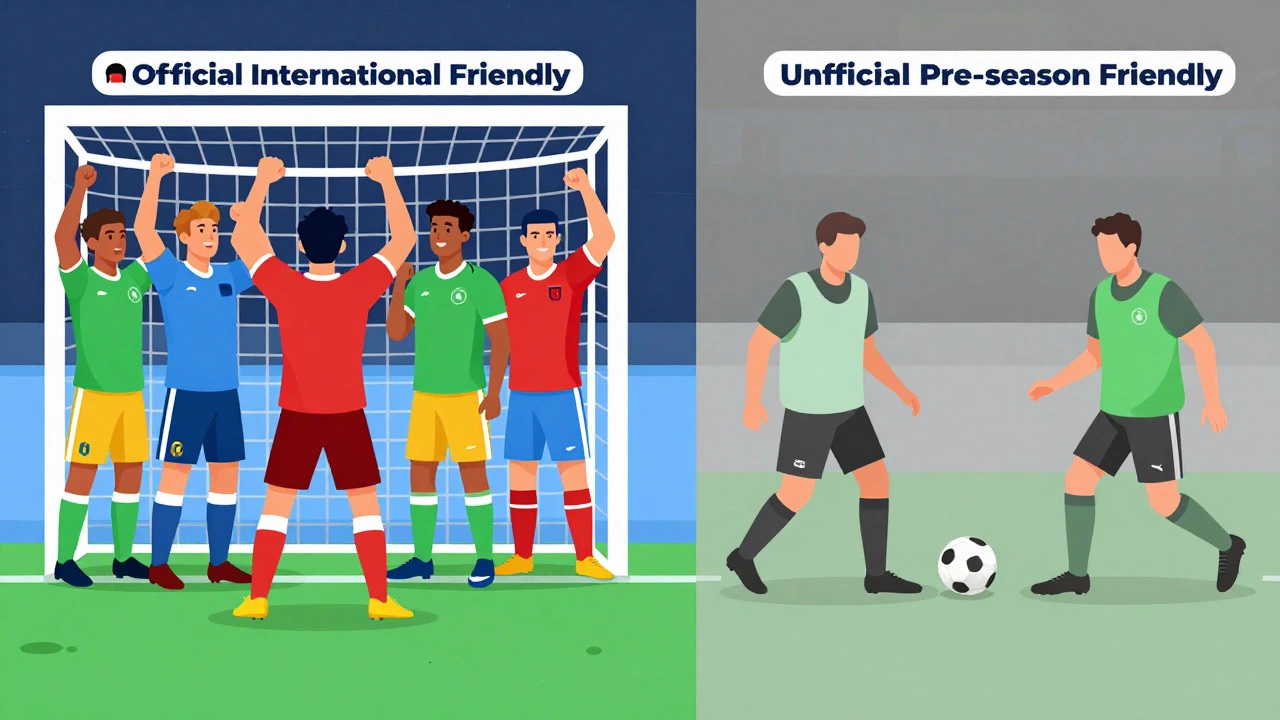
This is where it gets tricky. A "friendly" between two national teams can still be an official match. If England plays Brazil during the FIFA International Window, and both associations agree, and FIFA sanctions it, it is an official international friendly. The players earn caps (appearances for their country), and the goal scorers add to their international tallies. However, the result usually does not affect league standings or direct qualification paths, though it may impact FIFA World Rankings depending on the weighting system at the time.
| Match Type | Governing Body | Stats Recorded? | Impact on Standings/Rankings |
|---|---|---|---|
| League Game | Domestic League (e.g., Premier League) | Yes | Directly affects table position |
| International Friendly | FIFA / National Associations | Yes (Caps & Goals) | May affect FIFA Rankings |
| Pre-season Club Friendly | Club Agreement (Often Unsanctioned) | No (Usually) | None |
| Youth Academy Trial | Internal Club Structure | No | None |
Why Does It Matter? Consequences and Records
The label "official" carries weight because it dictates what enters the historical record. When we say Lionel Messi is the all-time top scorer for Argentina, we are counting only his goals in official matches. Goals he scored in charity exhibitions or unsanctioned club friendlies are excluded from this statistic.
For players, appearing in an official match for their national team earns them a "cap." This is a permanent mark of their service to their country. It also affects eligibility rules. For instance, once a player competes in an official senior match for one nation, they typically cannot switch to another unless specific residency or dual-nationality criteria are met under FIFA's Regulations on the Status and Transfer of Players.
For clubs, official matches determine financial distribution. Prize money from the Champions League is distributed based on performance in official group stage and knockout matches. Friendlies generate revenue through ticket sales and sponsorships, but they do not trigger the massive broadcasting rights payouts associated with official league play.
The Role of Governing Bodies
FIFA sits at the top of the pyramid, setting the Laws of the Game and overseeing international competitions. Below them are the six continental confederations, such as UEFA, the Union of European Football Associations for Europe. Each confederation manages its own club and national team competitions.
National associations, like the English FA or the Australian Football Federation, manage domestic leagues and cup competitions. They ensure that local matches comply with broader standards. If a local league wants its matches to be considered "official" in the eyes of FIFA-for example, to allow player transfers-they must adhere to specific organizational and administrative standards.

Common Misconceptions About Official Matches
Many fans assume that if a game is televised, it must be official. That is not always true. High-profile pre-season tours often feature major broadcasters covering friendlies between giants like Real Madrid and Bayern Munich. While widely watched, these games are often technically unofficial in terms of statistical recording, depending on the agreements made by the clubs and their respective federations.
Another myth is that youth matches are never official. This is incorrect. Youth Olympic Games or U-20 World Cups consist of official matches. Players earning caps at these levels are building their official international profiles, even if they are not yet seniors. However, a random school tournament is not an official match under FIFA statutes.
How to Verify if a Match Is Official
If you are unsure whether a specific game counts, check the source of the information. Official match centers on platforms like FIFA.com, UEFA.com, or the respective league’s website will list fixtures under "Competitions" or "Fixtures." Look for details about the referee appointment. Licensed referees are assigned to official matches weeks in advance. Unofficial games often use volunteer or lower-tier officials without formal central appointment.
Additionally, check post-match reports. Official matches require detailed technical reports submitted by the referee, including lineups, substitutions, and disciplinary actions. If no such report exists in the public domain of the governing body, the match likely lacks official status.
Do goals in friendly matches count towards a player's career total?
It depends on the type of friendly. Goals in official international friendlies (sanctioned by FIFA) count toward a player's international goal tally. However, goals in club friendlies or unsanctioned exhibitions usually do not count toward official professional statistics, although some media outlets may track them separately for context.
Can a club friendly become an official match retroactively?
Rarely. Once a match is played, its status is determined by the pre-game agreements and sanctions. If it wasn't sanctioned as official before kickoff, it generally remains unofficial. However, in rare cases of administrative errors, governing bodies might rectify records, but this is exceptional.
Are all World Cup qualifiers official matches?
Yes. All matches designated as part of the qualification process for the FIFA World Cup are official competitive matches. They carry significant weight for team rankings, player caps, and qualification standings.
Does playing in an official match affect a player's transfer value?
Indirectly, yes. Performance in official matches is tracked by scouts and analytics firms. Strong performances in high-pressure official games (like the Champions League) tend to increase a player's market value more than performances in friendlies, as official matches demonstrate consistency under regulated conditions.
What happens if an official match is abandoned?
If an official match is abandoned due to external factors (like weather or crowd trouble) before a certain time threshold (often 75-80 minutes), it is usually replayed from the start. If enough time has passed, the score at the moment of abandonment may stand, or a default win may be awarded, depending on the specific competition rules.