Brazil's Portuguese Language Timeline
Explore the journey: Click through each milestone to discover how treaties, exploration, and political decisions shaped Brazil's linguistic destiny.
Look at a map of South America. Almost every country speaks Spanish. Venezuela, Colombia, Peru, Argentina, Chile-they all share that linguistic heritage. Then there is Brazil. It takes up nearly half the continent, yet it speaks Portuguese. To anyone learning languages or traveling to Latin America, this seems like a massive exception. Why didn’t Spain claim such a huge chunk of land? Why did Portugal end up with the biggest prize in the New World?
The answer isn't just about luck. It’s about a combination of medieval treaties, ocean currents, royal marriages, and a specific moment when a prince decided to stay home instead of going to war. If you want to understand why Brazil is linguistically unique, you have to look back to the late 1400s and the way Europe divided the world.
The Line That Split the World: The Treaty of Tordesillas
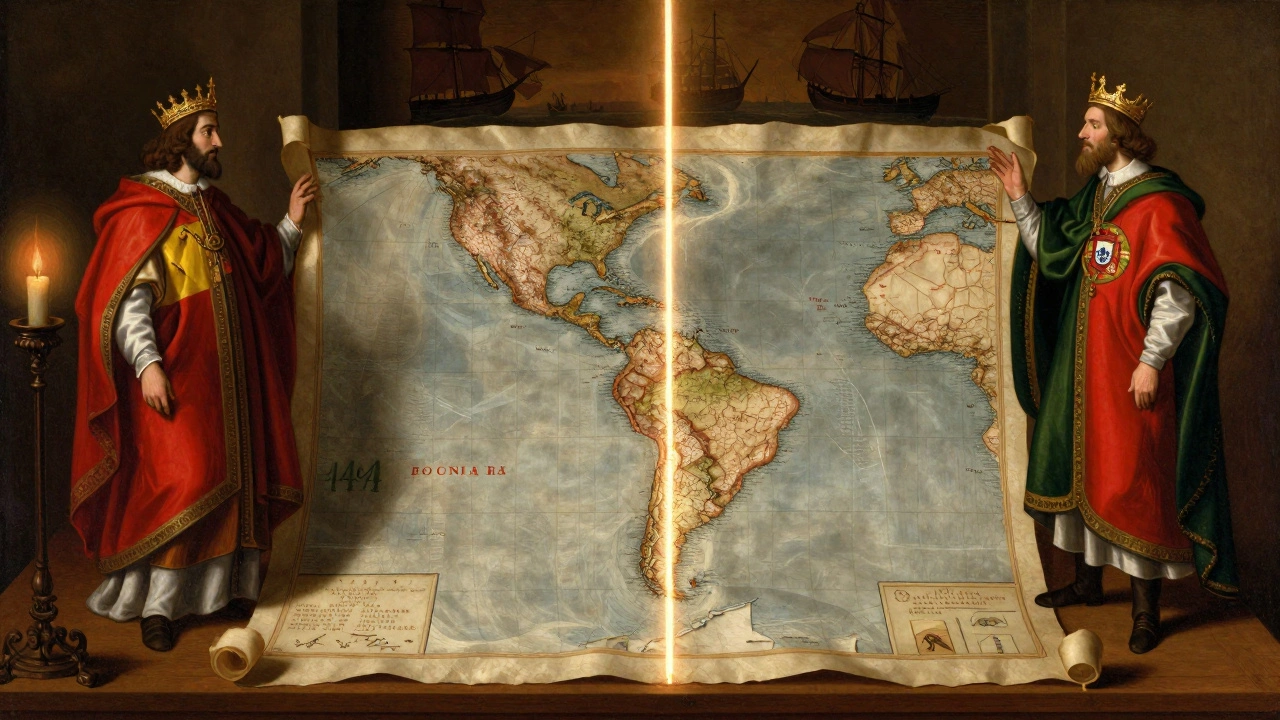
In 1494, two powerful empires were fighting over who got to explore and colonize the newly discovered lands across the Atlantic. These were Spain and Portugal. Both had incredible navigators-Columbus for Spain, Vasco da Gama for Portugal. They needed a rule to stop them from fighting each other.
The Pope stepped in and drew an imaginary line on the map. This became known as the Treaty of Tordesillas. The agreement was simple: anything discovered west of the line belonged to Spain. Anything east of the line belonged to Portugal. At the time, they thought the line would give Spain most of the Americas and Portugal the route to Asia through Africa.
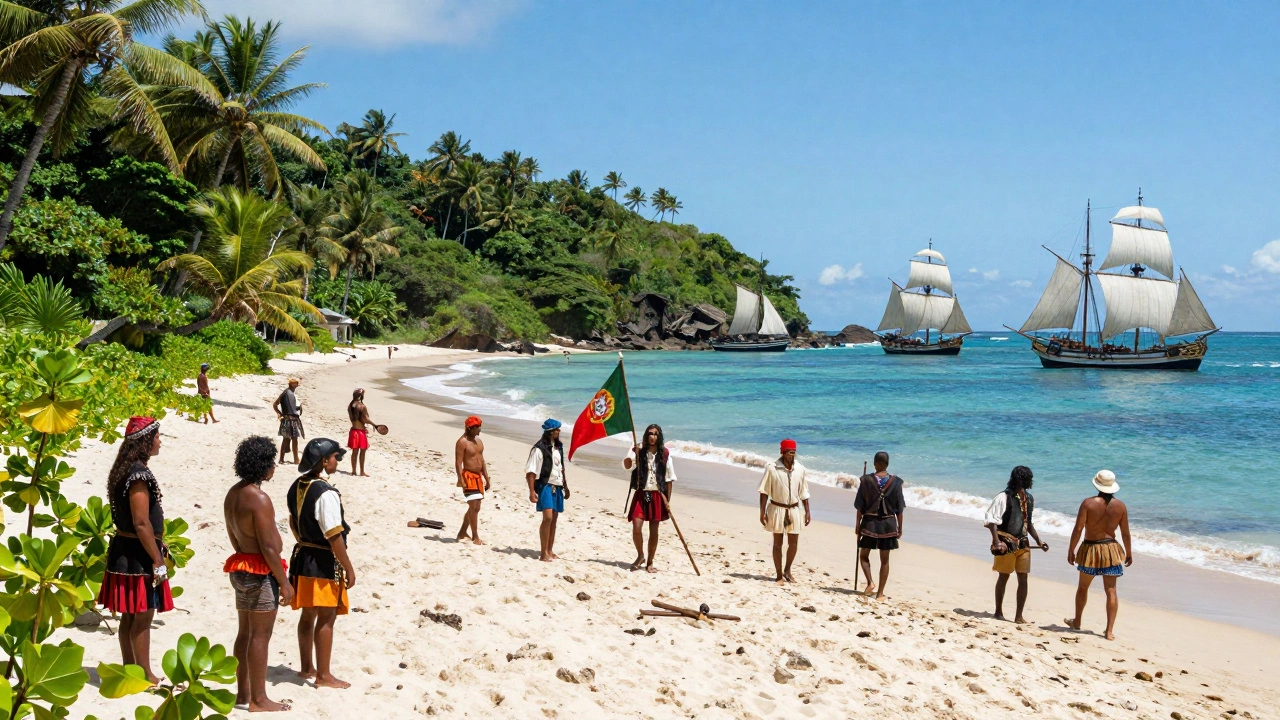
Here is where geography played a trick on everyone. No one knew exactly how big South America was. When Pedro Álvares Cabral, a Portuguese explorer, set sail in 1500, he veered far off course due to strong winds and ocean currents. He landed on the coast of what is now Bahia, Brazil. Because this land fell east of the Tordesillas line, it legally belonged to Portugal. If Cabral had landed just a few hundred miles further south or west, Brazil might have become Spanish-speaking today.
From Timber to Sugar: Building a Colonial Economy
Finding the land was only step one. Keeping it required money and people. In the early years, Brazil wasn't very exciting to the Portuguese crown. There was no gold, no silver, and no dense indigenous populations to tax immediately. However, the Portuguese soon found two things that made the colony worth keeping: Pau Brasil (brazilwood) and sugar.
Brazilwood was used to make red dye for clothes in Europe. It was valuable, but not enough to sustain a large population. Sugar changed everything. By the mid-1500s, sugar was "white gold." It was incredibly profitable. The Portuguese established large plantations called engenhos along the northeast coast. To run these plantations, they needed labor. Since the indigenous population resisted enslavement and many died from European diseases, the Portuguese began importing enslaved Africans.
This migration pattern shaped the language. Unlike Spanish colonies, which often brought in large numbers of Spanish settlers mixed with indigenous groups, Brazil developed a society heavily influenced by African culture and language alongside Portuguese. The need to manage vast sugar estates meant that Portuguese became the dominant administrative and commercial language, pushing aside indigenous tongues more aggressively than in some Spanish territories.
The Gold Rush and Moving the Capital
If Brazil stayed focused on sugar in the northeast, it might have remained a smaller, less significant part of the Portuguese empire. But then came gold. In 1693, miners found gold in the interior of Minas Gerais. This triggered a massive rush. People flooded into the region from all over Portugal and even from other parts of Brazil.
The center of gravity shifted. The capital moved from Salvador in the northeast to Rio de Janeiro in the southeast. This move was strategic. Rio provided better access to the mines and a safer harbor away from Dutch pirates who had been attacking the sugar coast. As the wealth grew, so did the city. Rio became a cosmopolitan hub, attracting more Europeans, including Germans, Italians, and French later on. But the official language remained firmly Portuguese because the administration, the church, and the economy were all tied to Lisbon.
The Royal Family's Unexpected Move
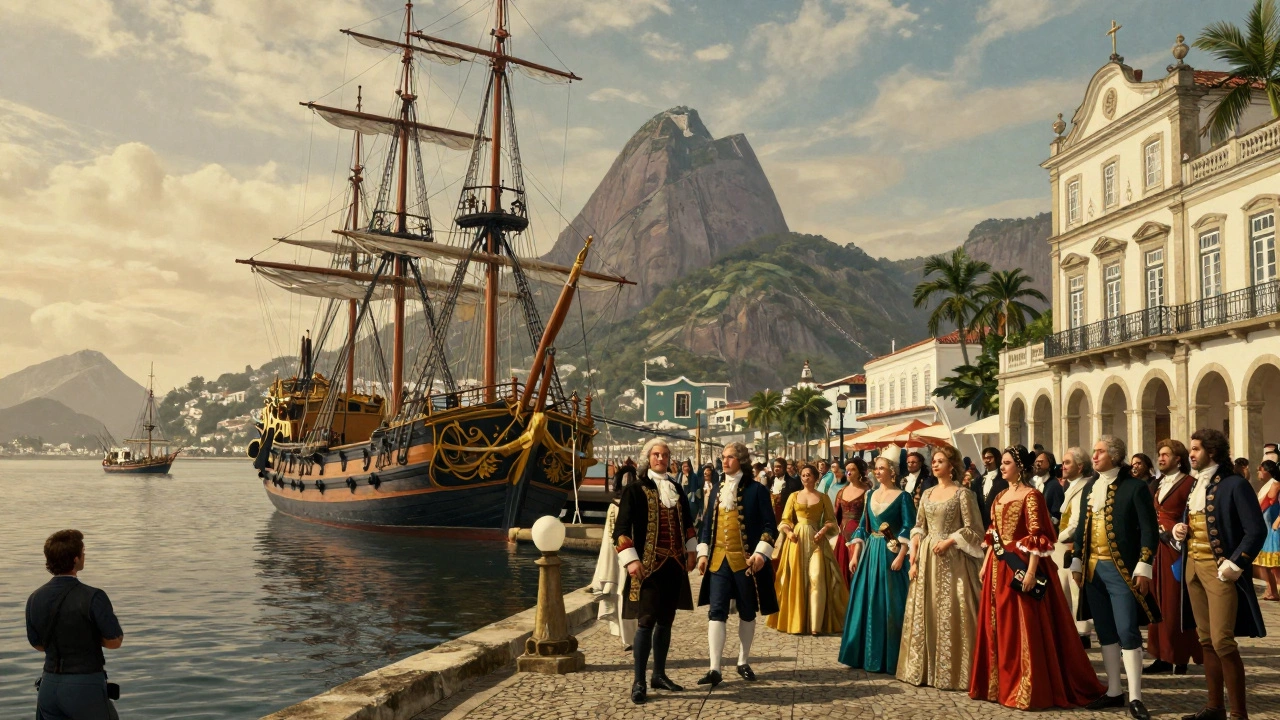
Usually, colonies are ruled from afar. The king stays in the home country, sending governors to manage the distant lands. But in 1807, something unusual happened. Napoleon Bonaparte invaded Portugal. Rather than let the French take their kingdom, the entire Portuguese royal family, led by King John VI, packed up and moved to Rio de Janeiro.
This was unprecedented. Never before had the capital of a European empire moved to its colony. For nearly 13 years, Rio de Janeiro was effectively the capital of the Portuguese Empire. The king opened ports to trade with other nations, not just Portugal. He built libraries, theaters, and printing presses. This elevated Brazil's status significantly. It stopped being just a resource dump and started looking like a nation in its own right. The presence of the court cemented Portuguese as the language of high culture, law, and politics in Brazil.
Independence Without Revolution
Most South American countries gained independence through bloody wars led by military heroes like Simón Bolívar. They fought against Spain and ended up speaking Spanish. Brazil’s path was different. When King John VI returned to Portugal in 1821, he left his son, Dom Pedro I, behind as regent.
The Portuguese parliament wanted to drag Brazil back to colonial status, taxing it heavily again. The Brazilian elites didn't want that. They liked their new freedom. On September 7, 1822, Dom Pedro declared independence. Crucially, he didn't declare a republic. He declared himself Emperor of Brazil. He kept the monarchy. He kept the language. He kept the legal system. Because the break was relatively peaceful and the leadership was already Portuguese-speaking, there was no incentive to switch to Spanish. Switching languages would have created chaos and disconnected the new nation from its existing institutions.
Why Spanish Was Never an Option
You might wonder if Brazilians ever considered switching to Spanish after independence. After all, almost all their neighbors spoke it. There were actually proposals to create a confederation of South American states under a single flag and possibly a unified language. Some intellectuals suggested adopting a standardized version of Spanish or even creating a new lingua franca.
But these ideas failed. By the mid-19th century, national identity was strengthening. The Portuguese language had evolved differently in Brazil compared to Portugal. It absorbed words from indigenous Tupi-Guarani languages and African languages. It developed its own rhythm and vocabulary. Adopting Spanish would have felt like losing a part of their identity. Furthermore, the elite class saw Portuguese as a marker of sophistication and connection to European markets, particularly Britain, which became Brazil's main trading partner after independence.
The Role of Immigration in Shaping Modern Brazilian Portuguese
In the late 19th and early 20th centuries, Brazil faced another shift. The abolition of slavery in 1888 meant the coffee plantations needed new workers. The government encouraged immigration from Europe. Millions of Italians, Germans, Japanese, and Poles arrived. You can still find Italian communities in southern Brazil where local dialects persist.
Despite this influx, Portuguese remained the glue. The immigrants learned Portuguese to integrate into the broader economy. The government enforced Portuguese in schools. This standardization helped unify the country. Imagine if every immigrant group kept their native tongue without a common language; Brazil might have fractured into multiple smaller nations. Instead, the shared language helped bind a massive, diverse territory together.
| Region/Country | Dominant Language | Colonial Power | Key Reason for Language Retention |
|---|---|---|---|
| Brazil | Portuguese | Portugal | Treaty of Tordesillas placement; Monarchical continuity |
| Argentina | Spanish | Spain | Viceroyalty of the Río de la Plata; Independence wars |
| Colombia | Spanish | Spain | New Granada Viceroyalty; Early exploration routes |
| Guyana | English | United Kingdom | British colonial control post-Napoleonic Wars |
Modern Implications: Mercosur and Communication
Today, the linguistic difference creates both challenges and opportunities. Brazil is a founding member of Mercosur, a trade bloc with Argentina, Uruguay, Paraguay, and others. Business meetings often require translators. However, the proximity means many Brazilians learn Spanish quickly. Studies show that Brazilians are generally much better at understanding Spanish than Spaniards are at understanding Portuguese. The sounds are similar, but the grammar and false friends (words that look alike but mean different things) can trip people up.
Culturally, this separation has allowed Brazil to develop a distinct media industry. Brazilian telenovelas, music (like Samba and Bossa Nova), and literature reach Spanish-speaking audiences but remain uniquely Brazilian. If Brazil spoke Spanish, it might have been culturally absorbed into the larger Hispanic market, potentially diluting its unique cultural exports.
Did Brazil ever consider switching to Spanish after independence?
There were brief discussions among some intellectuals about unifying South America under a single language, but the idea never gained traction. The political elite valued the distinction of Portuguese as a symbol of their monarchical heritage and connection to European markets. Additionally, the language had already diverged significantly from European Portuguese, making a switch to Spanish impractical and unpopular.
Is Brazilian Portuguese the same as European Portuguese?
They are mutually intelligible but have distinct differences. Brazilian Portuguese tends to be more open-voweled and retains more archaic features from older Portuguese, while European Portuguese often swallows vowels and uses different pronouns. Vocabulary also differs, similar to American vs. British English. For example, 'ônibus' is bus in Brazil, while 'autocarro' is used in Portugal.
Why didn't Spain try to take over Brazil?
Spain respected the Treaty of Tordesillas for most of the colonial period. While there were occasional border skirmishes, especially in the Amazon and southern regions, the major powers agreed on the division. Later, when Spain weakened during its own independence movements, it lacked the resources to challenge Portugal's hold on Brazil.
How does the language affect trade between Brazil and its neighbors?
It adds a layer of complexity requiring translation services and bilingual staff. However, it also positions Brazil as a bridge between the Lusophone world (including Angola and Mozambique) and the Hispanic world. Many Brazilian companies leverage this dual-language capability to expand across Latin America and Africa.
What role did indigenous languages play in Brazilian Portuguese?
Indigenous languages, particularly Tupi-Guarani, contributed significantly to Brazilian Portuguese vocabulary, especially regarding nature, animals, and plants. Words like 'abacaxi' (pineapple), 'ipê' (a tree), and 'café' (though via Arabic, often associated with local culture) reflect this influence. Place names across Brazil also derive from indigenous roots.