Rugby Origins Quiz
Loading question...
Quiz Complete!
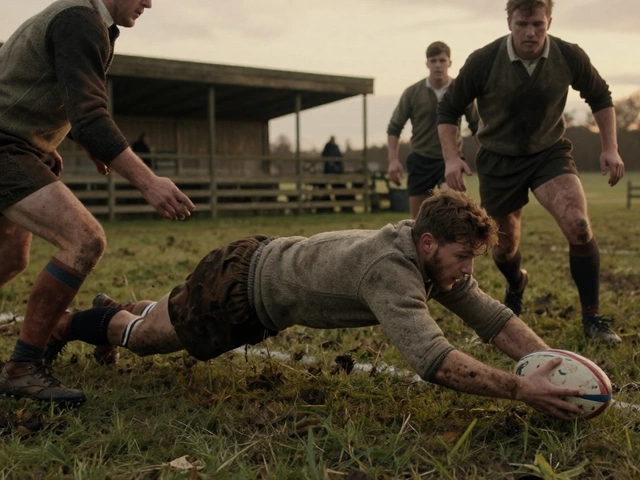
You’re watching a match, the crowd is roaring, and someone picks up the ball and runs. It looks like soccer, but they’re holding it. They’re tackling people. And suddenly, you realize: this isn’t just "football with hands." This is Rugby, a full-contact team sport played with an oval-shaped ball that originated in England in the early 19th century. But have you ever stopped to wonder why we call it that? It’s not called "Webb Ellis" or "Oval Ball Football." It’s named after a school.
It sounds simple enough, right? A place gives its name to a game. But the story behind that naming is tangled up in legend, class struggles, and a single moment of rule-breaking that changed global sports forever. If you’ve ever tried to explain the difference between rugby and soccer to a friend, or if you’ve wondered why the World Cup trophy doesn’t look like a giant cup of tea, you’re asking the right questions. Let’s unpack the real history behind the name.
The Legend of William Webb Ellis
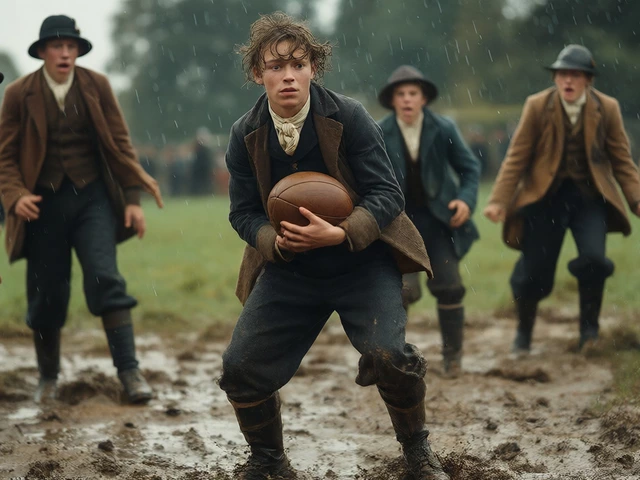
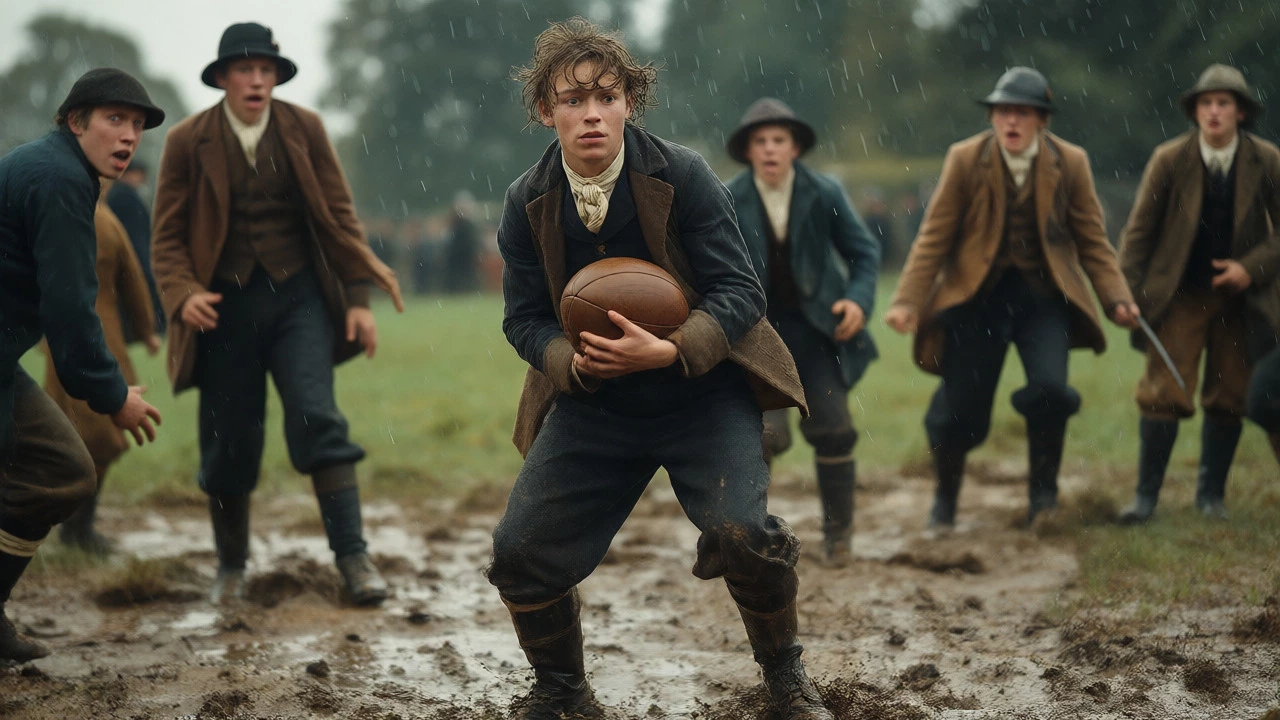
If you ask most rugby fans where the sport came from, they’ll tell you about William Webb Ellis. The story goes that in 1823, at Rugby School in Warwickshire, England, a student named Webb Ellis got frustrated during a football match. He picked up the ball and ran with it toward the opposing goal. His teammates were shocked. His opponents were furious. But he did it anyway.
This act of defiance supposedly created the distinct identity of rugby football, separating it from the kicking-focused games that would eventually become association football (soccer). For decades, this was accepted as historical fact. There’s even a statue of him at the entrance to Rugby School, holding a ball, looking defiantly into the distance.
But here’s the kicker: historians aren’t entirely sure it happened exactly like that. While Webb Ellis was indeed a student at Rugby School around that time, there are no contemporary accounts of him picking up the ball and running. The first written mention of this specific incident didn’t appear until 1876, more than 50 years later. So, while the myth is powerful-and arguably helped unify the sport’s identity-the literal truth is murky. What we do know is that Rugby School was a hotbed for evolving football rules, and Webb Ellis became the symbolic face of that evolution.
Rugby School: Where the Rules Were Written
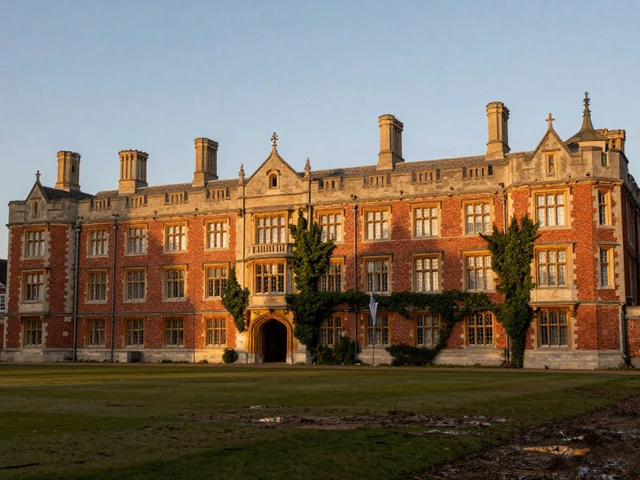
If the name comes from the place, then understanding the place is key. Rugby School wasn’t just any boarding school. In the early 1800s, English public schools had their own chaotic versions of football. Each school had different rules. Some allowed carrying the ball; others didn’t. Some played on muddy fields; others used narrow lanes between houses.
In 1845, three students at Rugby School-W.D. Arnold, F. Hutchins, and W. Shirley-wrote down the first set of formalized rules for what they called "Rugby Football." These rules codified practices that had been developing informally for years. Crucially, these rules allowed players to carry the ball forward, provided they threw it backward when passing. This distinction is the genetic code of modern rugby.
Because these rules were published and widely circulated among other British schools and universities, the style of play associated with Rugby School spread. When other institutions adopted these specific rules, they started calling the game "Rugby" to distinguish it from other forms of football. The name stuck because it identified the *source* of the rules, much like how we might say "Texas Hold'em" poker to specify the variant.

The Great Schism: Rugby vs. Soccer
To truly understand why the name matters, you have to look at the split that defined modern football codes. By the mid-19th century, there were two main camps: those who wanted to ban hacking (kicking shins) and handling the ball, and those who wanted to keep them. This debate came to a head in 1863 with the formation of the Football Association (FA) in London.
The FA decided that handling the ball would be banned, except for throw-ins and catching a fair catch (which was later removed too). Clubs that agreed with these new rules became part of "Association Football," which was shortened to "Soccer" (from the "-er" suffix common in Oxford slang, i.e., Assoc-er). Clubs that disagreed, particularly those aligned with Rugby School traditions, refused to join the FA. They kept playing their way: carrying the ball, tackling, and scoring by grounding the ball over the line.
These dissenting clubs formed the Rugby Football Union (RFU) in 1871. From that point on, the term "Rugby" became the official identifier for the code that permitted handling. So, the name wasn’t just a geographic label anymore; it became a political statement about how the game should be played. If you play by the RFU rules, you’re playing Rugby. If you play by FA rules, you’re playing Soccer. The name tells you the rulebook.
From Schoolyard to Global Phenomenon
Once the name was established in Britain, it traveled fast. British colonialism and trade routes exported the sport to Australia, New Zealand, South Africa, France, and beyond. Because the game was already branded as "Rugby," it kept that name globally. Unlike cricket, which adapted names in some regions, or baseball, which has regional variants, Rugby maintained its brand integrity.
This consistency helps explain why a fan in Adelaide can watch a match in Paris and recognize the core mechanics instantly. The name carries the legacy of those original Rugby School rules. Even when the sport split again in 1895 into Rugby League and Rugby Union, both retained the root word. Why? Because despite differences in player numbers and substitution rules, both codes still share the fundamental DNA of carrying the ball forward-a direct lineage from that 1845 rulebook.
Today, the name is protected and managed by bodies like World Rugby. They ensure that when you see the word "Rugby," you’re getting a standardized experience. Whether it’s the seven-a-side format seen in the Olympics or the fifteen-a-side test matches, the name signals a specific set of values: physicality, respect for the referee, and a unique blend of strategy and brute force.

Common Misconceptions About the Name
People often get confused about the relationship between rugby and American football. You might hear someone say, "Isn't rugby just American football without pads?" Not quite. American football evolved from rugby, yes, but it diverged significantly. The NFL added forward passes, downs, and protective gear, creating a stop-start rhythm that differs vastly from rugby’s continuous flow.
Another misconception is that "Rugby" refers to the town of Rugby itself. While the school is located there, the town isn’t famous for the sport in the same way Manchester is for United or Liverpool for its club. The fame belongs to the institution, not the municipality. If you visit Rugby, England, you’ll find a quiet market town with a historic school, not a bustling stadium district. The name is an institutional brand, not a geographic one in the modern sense.
| Aspect | Popular Myth | Historical Reality |
|---|---|---|
| Originator | William Webb Ellis invented it alone in 1823. | Rules evolved collectively at Rugby School; Ellis is a symbolic figure. |
| First Rules | Written immediately after Ellis's run. | Codified in 1845 by students, 22 years after the alleged incident. |
| Name Source | Named after the town of Rugby. | Named after Rugby School due to its influence on rule standardization. |
| Soccer Split | Happened naturally over time. | A formal break in 1863/1871 due to disagreements on handling and hacking. |
Why the Name Matters Today
You might think, "Who cares? It’s just a name." But language shapes perception. Calling it "Rugby" emphasizes its origins in education and tradition. It connects the modern athlete to a 200-year-old lineage. When a player sings "Swing Low, Sweet Chariot" before a match, they’re participating in a ritual tied to that specific cultural heritage.
Furthermore, the name helps navigate the complex landscape of contact sports. With the rise of flag football, touch rugby, and tag rugby, the base term "Rugby" acts as an umbrella. It signals the core mechanic: the oval ball and the tackle. Without that clear naming convention derived from Rugby School, we’d likely have a dozen different names for similar games, making international competition and governance a nightmare.
So, next time you watch a scrum form, remember: you’re watching a living museum piece. The huddle, the binding, the pushing-it all traces back to boys in Victorian England trying to make sense of chaos on a muddy field. They named it after their home, and the world followed suit.
Did William Webb Ellis actually invent rugby?
Probably not in the way the legend suggests. While Webb Ellis was a student at Rugby School in the 1820s, there is no contemporary evidence that he single-handedly invented the game by picking up the ball. The story emerged decades later. However, his name became synonymous with the sport’s founding mythology, and the World Cup trophy is named after him.
Is Rugby named after the town or the school?
It is named after Rugby School. The school developed and codified the specific rules that distinguished this version of football from others. As these rules spread to other schools and clubs, the game became known as "Rugby Football" to identify the source of the regulations.
Why is soccer not called rugby?
In 1863, the Football Association (FA) banned carrying the ball. Clubs that agreed with this rule formed Association Football (later nicknamed Soccer). Clubs that wanted to keep carrying the ball broke away and formed the Rugby Football Union in 1871. The names reflect this historical split in rulebooks.
Are Rugby League and Rugby Union the same sport?
They are related but distinct codes. Both stem from Rugby Union, but in 1895, northern English clubs broke away to form Rugby League over payment issues. League has 13 players per side and fewer rucks, while Union has 15 players and more complex set pieces like scrums and lineouts. Both retain the "Rugby" name because they share the same foundational rules regarding ball handling.
Does the name "Rugby" have any other meanings?
Primarily, it refers to the sport. However, "Rugby" is also a surname and a place name. In casual conversation, it almost exclusively refers to the sport unless context specifies otherwise. The term "Rugger" is sometimes used as slang for Rugby Union, particularly in the UK, but "Rugby" remains the standard global identifier.