
Boxing Title Match Quiz
Test your understanding of boxing title matches with this 5-question quiz. Each question has one correct answer.
1. What defines a title match in boxing?
2. Which of the following is NOT one of the four major sanctioning bodies?
3. What happens if a champion can't defend their title within the required timeframe?
4. What is an undisputed champion in boxing?
5. How many rounds is a standard world title match in boxing?
Quiz Results
When you hear the phrase title match in boxing, it doesn’t just mean any fight. It’s the big one. The fight that matters most. The one where a boxer isn’t just trying to win - they’re trying to hold onto, win, or take away a world championship belt. These aren’t exhibition bouts or tune-up fights. Title matches are the peak of the sport, where careers are made, legacies are built, and sometimes, shattered.
What Exactly Is a Title Match?
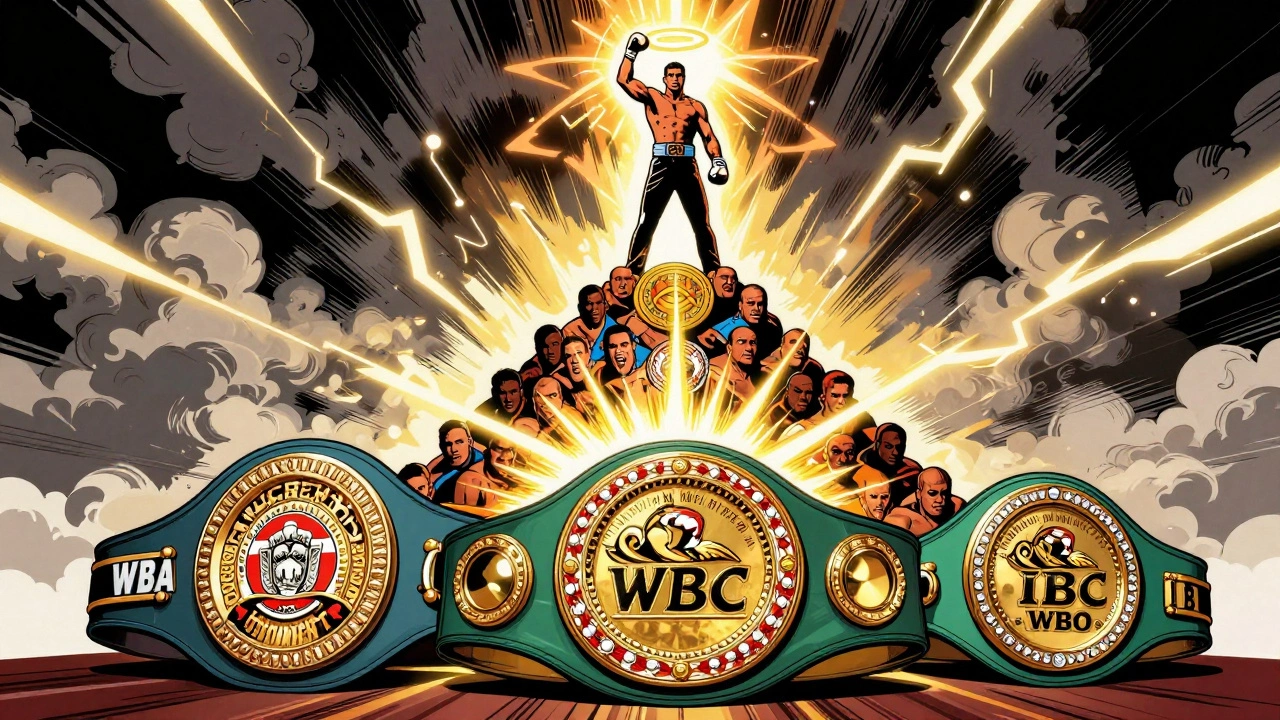
A title match in boxing is a sanctioned fight for a recognized world championship belt. These belts are awarded by the four major sanctioning bodies: the WBA (World Boxing Association), WBC (World Boxing Council), IBF (International Boxing Federation), and WBO (World Boxing Organization). Each of these organizations has its own champion in every weight class - from strawweight all the way up to heavyweight.
When a boxer holds one of these belts, they’re the official world champion. And when they step into the ring to defend it, that’s a title defense. When someone else challenges them for it, that’s a title fight. Either way, it’s a title match.
These aren’t just fights with extra hype. They’re governed by strict rules. The challenger has to earn their shot - usually by winning a series of high-level fights, climbing the rankings, and being named the mandatory challenger. The champion can’t just pick any opponent. There’s a system. A hierarchy. And the title match sits right at the top of it.
Why Do Title Matches Matter So Much?
Think of it like this: a regular fight is like a midweek game in soccer. A title match is the final of the World Cup. The stakes aren’t just about who wins that night. They’re about legacy. Money. Recognition. And history.
Winning a title match means you’re officially the best in the world at your weight class. You get your name on a belt that’s been held by legends - Muhammad Ali, Mike Tyson, Manny Pacquiao, Canelo Álvarez. You get paid more. You get headline spots. You get TV deals. You become the face of the sport.
And if you lose? You’re not just out of the title. You’re often out of the top tier. The boxing world moves fast. There’s always another fighter waiting to take your spot.
How Do You Get a Title Match?
You don’t just sign up. You earn it.
Boxers climb the rankings by fighting consistently, winning decisively, and beating ranked opponents. Each sanctioning body has its own ranking system. If you’re in the top 15, you’re in the mix. If you’re in the top 5, you’re a serious contender. And if you’re the number one ranked fighter? You’re the mandatory challenger.
The champion has to defend their title against the mandatory challenger within a certain time frame - usually 6 to 12 months. If they don’t, they can be stripped of the belt. That’s why you see so many title fights happen so often. It’s not just because fans want them. It’s because the rules demand it.
There are exceptions. Sometimes, champions choose to fight a bigger name - a star, a fan favorite - even if they’re not ranked number one. That’s called a “non-mandatory” defense. But those fights still count as title matches. The belt is still on the line.

What Happens When a Title Is Vacated?
Not every title fight ends with one fighter keeping the belt. Sometimes, the belt is vacated. That means no one holds it anymore.
Why? Maybe the champion retired. Maybe they moved to a different weight class. Maybe they got injured and couldn’t defend it in time. Maybe they refused to fight the mandatory challenger. Or maybe, in rare cases, the organization stripped them for failing a drug test or breaking rules.
When a title is vacated, the sanctioning body usually orders a fight between the top two ranked fighters to crown a new champion. That’s called a “title unification bout” if multiple belts are involved - or just a “title fight” if it’s for one belt.
These fights are especially intense. There’s no defending champion. Just two fighters, one belt, and everything on the line.
Unification and Undisputed Titles
Here’s where things get really interesting.
Since there are four major organizations, it’s common to have four different champions in the same weight class. That means four different belts. A fighter might hold one. Another holds another. That’s confusing for fans - and it’s messy for the sport.
That’s why unification fights happen. When two champions fight each other - say, the WBC champ vs. the IBF champ - they’re not just fighting for one belt. They’re fighting to become the undisputed champion. If one fighter wins, they hold two belts. If they go on to beat the other two champions? They become the undisputed champion. All four belts in one name.
Undisputed champions are rare. Only a handful have been crowned in the last 20 years. When it happens, it’s historic. It’s the closest thing boxing has to a true world champion.
What’s the Difference Between a Title Match and a Non-Title Fight?
It’s simple: the belt.
In a non-title fight, the winner gets a win on their record. Maybe a payday. Maybe some momentum. But no belt. No official recognition as world champion.
In a title match, the belt is on the line. The outcome changes your legacy. The fight is longer - usually 12 rounds. The fighters are top-tier. The promoters spend millions on TV rights. The world watches.
Even the pre-fight buildup is different. Title fights have press tours. Global media coverage. Weight checks on live TV. Fan events. The whole circus. Non-title fights? They’re often on undercards. Quiet. Low-key.
What About Regional and Minor Titles?
You might hear about fighters holding “interim” belts, “silver” belts, or regional titles like the WBC Asian title. These aren’t world titles. They’re stepping stones.
An interim title is usually given when the real champion is injured or can’t defend. It’s temporary. The interim champ has to fight the real champ when they return - and if they win, they become the official champion.
Regional titles help fighters build their record and get noticed. But they don’t carry the same weight. A fighter can hold five regional belts and still not be considered a world champion. Only the WBA, WBC, IBF, and WBO belts do that.
Why Do Some Title Fights Feel More Important Than Others?
Because not all title matches are created equal.
A fight between two unknown champions? It might fly under the radar. A fight between a legend like Canelo Álvarez and a rising star like Jermall Charlo? That’s a global event.
It’s not just about the belts. It’s about the fighters. The history. The rivalry. The money. The media.
Some title fights are unification bouts. Some are rematches. Some are revenge fights. Some are last chances. The context turns a title match into something bigger than a championship.
That’s why people still remember fights like Tyson vs. Holyfield, Mayweather vs. Pacquiao, or Fury vs. Wilder. They weren’t just title matches. They were cultural moments.
Final Thought: The Real Meaning of a Title Match
At the end of the day, a title match in boxing is more than a fight. It’s a test of everything - skill, heart, preparation, and nerve. It’s the moment a boxer steps into the ring not just to win, but to prove they belong among the greatest.
That’s why every title match carries weight. Whether it’s in Las Vegas, London, or Manila. Whether it’s on pay-per-view or live TV. Whether you’re watching from a couch or in a packed arena.
It’s not just about the belt.
It’s about legacy.
Is every championship fight a title match?
No. Only fights for belts recognized by the four major sanctioning bodies - WBA, WBC, IBF, and WBO - count as official title matches. Regional titles, interim belts, and minor championships don’t qualify as world title fights.
Can a boxer hold more than one title at the same time?
Yes. Many champions hold multiple belts simultaneously, especially after unification fights. Fighters like Canelo Álvarez and Oleksandr Usyk have held all four major belts in their weight class, becoming undisputed champions.
What happens if a champion can’t defend their title?
If a champion can’t defend their title within the required time frame - usually 6 to 12 months - the sanctioning body can strip them of the belt. The mandatory challenger then gets a shot at the vacant title, often against the next top-ranked fighter.
Why are there four different boxing organizations?
The four organizations evolved over time due to historical splits, regional interests, and power struggles within boxing. Each has its own rules, rankings, and champions. While this creates confusion, it also creates more opportunities for fighters to compete for titles.
Do title matches always go 12 rounds?
Yes. All world title matches are scheduled for 12 rounds. Non-title fights can be 8, 10, or 12 rounds depending on the fighters’ experience and the promoter’s decision. But for a world title, it’s always 12.