Cross Country Efficiency Calculator
Your Running Profile
(Lower is more efficient)
This bar represents your weight load relative to an elite XC runner's typical power-to-weight efficiency metric.
Why This Matters
According to the article, XC runners are "skinny" because of the brutal math of energy expenditure versus caloric intake.
- Dead Weight: Every extra pound requires more force to lift against gravity with each stride.
- Thermoregulation: Leaner bodies dissipate heat faster, preventing overheating during long efforts.
- Type I Fibers: Endurance muscles are dense but don't bulge, contributing to a wiry look.
Elite male XC runners often burn 4,000-6,000 calories a day. Use this tool to estimate your own output and understand the "Metabolic Furnace" concept.
You’ve seen them. They look like they could be blown away by a stiff breeze, yet they sprint up hills that leave the rest of us gasping for air. If you’re new to long-distance running, especially cross country, it’s easy to assume these athletes are starving themselves or have some genetic lottery ticket that lets them eat pizza and stay wiry. But the reality is far more biological and less about willpower.
The lean physique of elite cross-country (XC) runners isn’t an accident. It’s a direct result of how their bodies adapt to extreme aerobic demands. When we talk about why XC runners are so skinny, we aren't just talking about aesthetics; we're talking about efficiency, thermoregulation, and the brutal math of energy expenditure versus caloric intake.
The Physics of Running: Power-to-Weight Ratio
Running is essentially a repetitive act of throwing your body weight into the air and catching it. In physics terms, this requires force. The heavier you are, the more energy it takes to move forward against gravity. This is where the concept of power-to-weight ratio becomes critical. Unlike cycling, where aerodynamics and raw wattage dominate, running is purely about moving mass over distance.
For an XC runner, every extra pound of body fat is dead weight. It doesn’t contribute to propulsion; it only adds load. Elite runners naturally select for lighter frames because those bodies can generate the necessary speed with less metabolic cost. Think of it like driving a car: a lightweight sports car uses significantly less fuel to reach high speeds than a heavy SUV. XC runners are the sports cars of the athletic world.
| Runner Type | Avg. Body Fat % | Primary Fuel Source | Key Advantage |
|---|---|---|---|
| Cross Country / Marathon | 5-8% (Men), 10-13% (Women) | Fat Oxidation & Glycogen | Efficiency & Endurance |
| Sprinter (100m/200m) | 6-10% | ATP-PC System (Explosive) | Raw Power & Speed |
| Ultra-Endurance | 8-12% | Fat Oxidation | Muscular Durability |
Thermoregulation: Staying Cool Under Pressure
One of the most overlooked reasons for the skinny build is heat management. Running generates massive amounts of internal heat. Your muscles are engines, and engines get hot. To prevent overheating, your body must dissipate this heat through sweat and blood flow to the skin.
Body fat acts as insulation. While this is great for surviving winter in Antarctica, it’s a nightmare for a runner trying to maintain pace on a humid summer day. A thinner layer of subcutaneous fat allows heat to escape the core much faster. Elite XC runners often train in environments where core temperature regulation is the difference between finishing strong and collapsing from heat exhaustion. Their bodies have adapted to minimize insulation to maximize cooling efficiency.
The Metabolic Furnace: Caloric Deficit vs. Adaptation
Let’s talk numbers. An elite male XC runner might burn between 4,000 to 6,000 calories a day during peak training seasons. That’s not a typo. To maintain a lean physique, they don’t necessarily eat *less* than average people; they simply cannot consume enough to offset the output without gaining muscle mass, which would hurt their performance.
This creates a natural caloric deficit. Even if they try to eat more, their metabolism adapts. This phenomenon, known as adaptive thermogenesis, means their bodies become more efficient at burning energy at rest. You see this in many endurance athletes who struggle to gain weight even when eating large volumes of food. It’s not that they are restricting calories intentionally; it’s that their physiological engine is so tuned for combustion that storage becomes difficult.
Muscle Fiber Composition: Type I Dominance
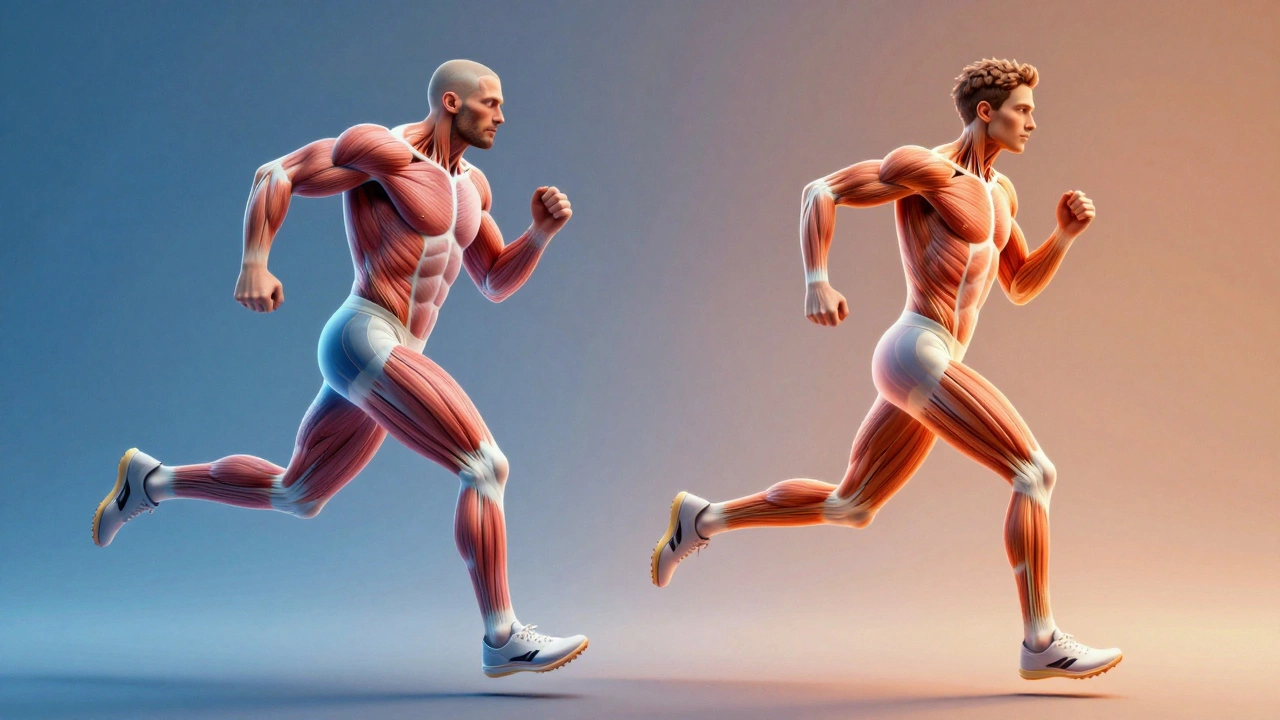
Not all muscle is created equal. Human muscle fibers fall into two main categories: Type I (slow-twitch) and Type II (fast-twitch). Type I fibers are designed for endurance. They are small, dense with mitochondria (the cell’s powerhouse), and highly resistant to fatigue. Type II fibers are larger, explosive, and fatigue quickly.
XI runners rely almost exclusively on Type I fibers. These fibers do not hypertrophy (grow in size) easily. No matter how much you train, slow-twitch fibers won’t bulge like the fast-twitch fibers found in sprinters or weightlifters. This is why XC runners look "skinny" rather than "muscular." Their muscles are dense and efficient, but they lack the girth associated with anaerobic power.
- High Mitochondrial Density: More energy production per unit of muscle.
- Capillary Network: Enhanced oxygen delivery to tissues.
- Low Glycogen Storage: Less water retention in muscles compared to power athletes.
Genetics vs. Training: The Nature/Nurture Debate
While training shapes the body, genetics load the gun. Studies on elite endurance athletes show a strong correlation with specific genetic markers, such as the ACTN3 gene variant. However, it’s not just about DNA. It’s about recruitment. Coaches and athletes self-select into disciplines where their body type gives them an advantage.
If you have a naturally stocky build, you might find yourself excelling in the 400m hurdles or rugby. If you are naturally ectomorphic (lean and linear), you’ll likely thrive in the 5k or marathon. Over time, the pool of XC runners filters out those who don’t fit the physiological mold, creating a homogeneous group of athletes who all look similar. This is survivorship bias in action.

Is This Body Type Healthy for Everyone?
Here is the crucial part: Do not try to copy this physique unless you are training 20+ hours a week. For the average person, the lean frame of an XC runner is a result of extreme stress on the body. Attempting to achieve this look through diet alone, without the accompanying cardiovascular adaptation, can lead to hormonal imbalances, bone density loss, and metabolic slowdown.
Healthy running involves finding a balance. You want enough fuel to recover and enough strength to prevent injury. The "skinny" look is a side effect of elite performance, not the goal itself. Focus on how you feel, your pace, and your consistency, rather than mimicking the waistline of an Olympian.
Training Implications for Recreational Runners
If you are looking to improve your own endurance, you don’t need to lose weight to run better. However, understanding these principles can help optimize your training:
- Zone 2 Training: Spend most of your time running at a conversational pace to build mitochondrial density.
- Hill Repeats: Improve power-to-weight ratio by strengthening legs without adding bulk.
- Nutrient Timing: Eat carbohydrates around workouts to fuel performance, not just to restrict calories.
Remember, the goal is longevity in the sport. The skinniest runner isn’t always the fastest, but the most efficient one usually wins. As you progress in your marathon training or XC journey, let your body adapt naturally. Trust the process, listen to your hunger cues, and respect the biology that makes these athletes what they are.
Do all marathon runners have to be skinny?
No. While elite marathoners tend to be lean due to the efficiency benefits, recreational marathon runners come in all shapes and sizes. Many successful amateur runners carry more muscle mass or body fat and still complete races successfully. The key is relative fitness, not absolute weight.
Can I change my body type through running?
You can reduce body fat and increase muscular endurance, but you cannot change your fundamental skeletal structure or muscle fiber distribution. Genetics play a huge role in whether you will look like a sprinter or a distance runner. Focus on health metrics rather than aesthetic changes.
Why do XC runners have small calves?
XC runners rely on elastic energy return from their Achilles tendon and arches rather than bulky calf muscles. Large calf muscles require more oxygen and energy to sustain. Smaller, denser calves are more efficient for the repetitive, low-impact motion of distance running.
Is being too skinny bad for running performance?
Yes. Being underweight can lead to Relative Energy Deficiency in Sport (RED-S), formerly known as the Female Athlete Triad. This condition causes hormonal disruptions, increased injury risk, and poor bone health. Adequate fueling is essential for recovery and performance, regardless of body size.
How does altitude training affect body composition?
Altitude training increases red blood cell count, improving oxygen delivery. It doesn’t directly cause weight loss, but the reduced appetite often experienced at high altitudes, combined with intense training, can lead to a leaner physique. However, the primary benefit is physiological, not cosmetic.